

Weekly Economic Update 07-31-26: Durable Goods; Case-Shiller Home Price Index; Consumer Confidence; Personal Income & Spending; 2nd Quarter GDP; and PCE Inflation
The consumer stepped up big in the second quarter, but it wasn't enough as GDP still came in well below expectations.
The views and opinions expressed in this post are solely those of the author and do not necessarily reflect the views of the Georgia Institute of Technology or the Georgia Board of Regents.
Wednesday, the Federal Reserve chose to hold rates steady in the 3.50%–3.75% range — the seventh straight meeting with no move (full statement here). But the vote was 9-3, and all three dissenters wanted rates higher. Beth Hammack, Neel Kashkari, and Lorie Logan each preferred a quarter-point hike on the spot. That is the first time since the fall of 2016 that three policymakers have broken ranks in the same direction — and interestingly, all three are regional bank presidents, not Washington appointees.
But the Kashkari vote is the one that made me laugh.
You remember Kashkari…I have written about him before. Back in June 2021, with inflation already climbing, the Minneapolis president was on record opposing any rate hike until after 2023. As late as the middle of 2022, he was still willing to say the word “transitory” out loud. His only two dissents in nine years — February and March of 2017 — were both votes against raising rates, on the grounds that core inflation was 1.7% and the Fed was crying wolf. Now, he’s the loudest voice calling for a rate hike. Don’t tell me politics hasn’t worked its way into the central bank. When their own guy is in office, rates need to stay low…when the other guy is in office, suddenly everyone is an inflation hawk.
At least we know there are three votes to raise rates in September. But the bond market isn’t buying it. The 30-year jumped about 11 points to 5.21% — the highest it has been in 19 years. In other words, traders don’t think this Fed is about to get aggressive. Oh, they will talk tough, wait, and then let inflation run a while longer. Warsh all but confirmed that, suggesting that rising long-term yields are doing the tightening for him! Jack McIntyre at Brandywine Global put it plainly: “The long end doesn’t buy into his inflation-fighting story.” Neither do I.
For five years now, inflation has been above “target.” Headline CPI is 3.5% and core CPI 2.6%, which sounds like progress until you notice that core producer prices are running at 5.1% — that is the cost pressure that hasn’t reached your pocket yet. Plus, on a three-month annualized basis, money is growing at an annual rate of 8.7%. In May alone, it grew at a 13.8% annual rate.
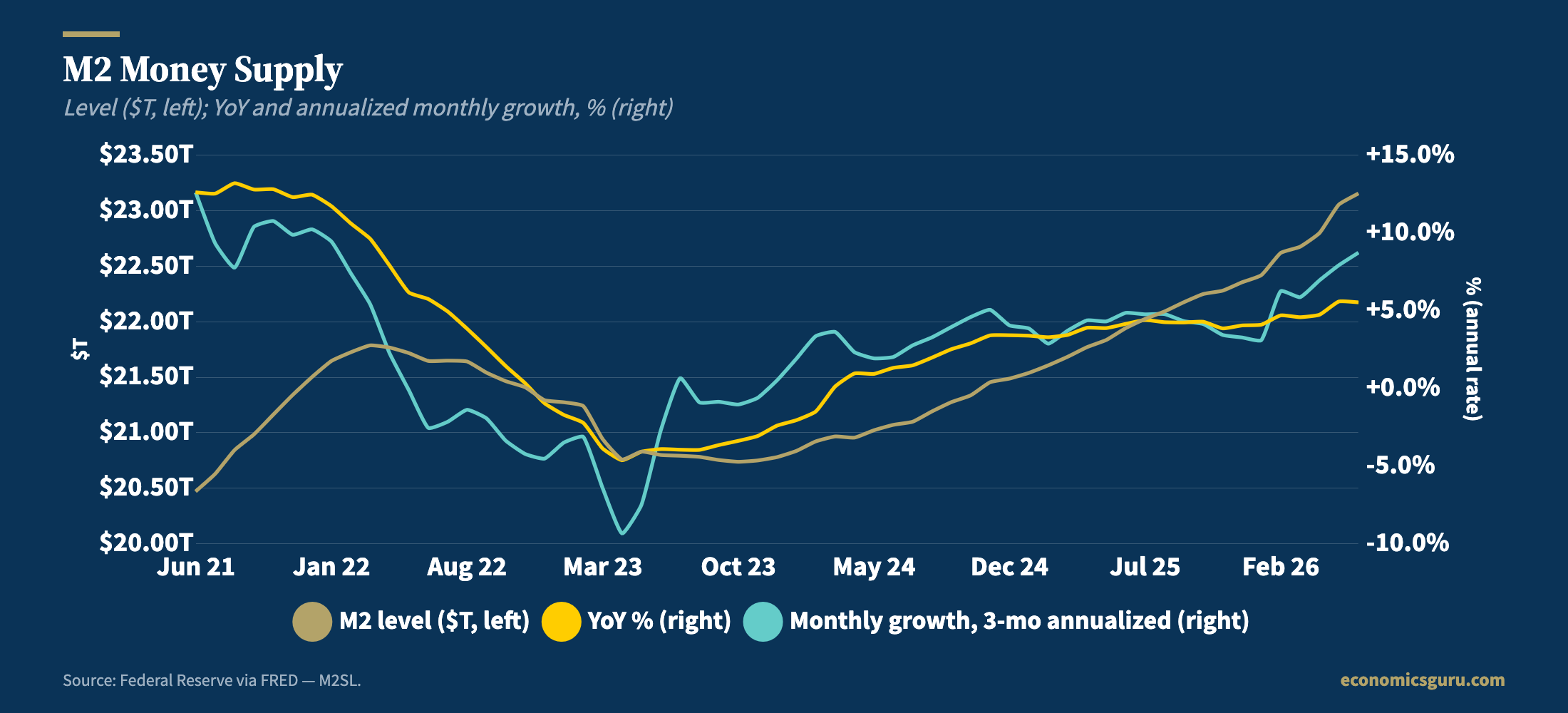
If you don’t hit your “target” for five years, maybe you should either change your target or adjust your aim. But standing around hoping that things are going to get better isn’t a plan...it’s incompetence.
Durable Goods
The week started with the Census Bureau releasing the June advance report on durable goods (full release here), and the headline was a disappointment: new orders were up 0.3% to $334.8 billion, against a consensus looking for 2.5%.
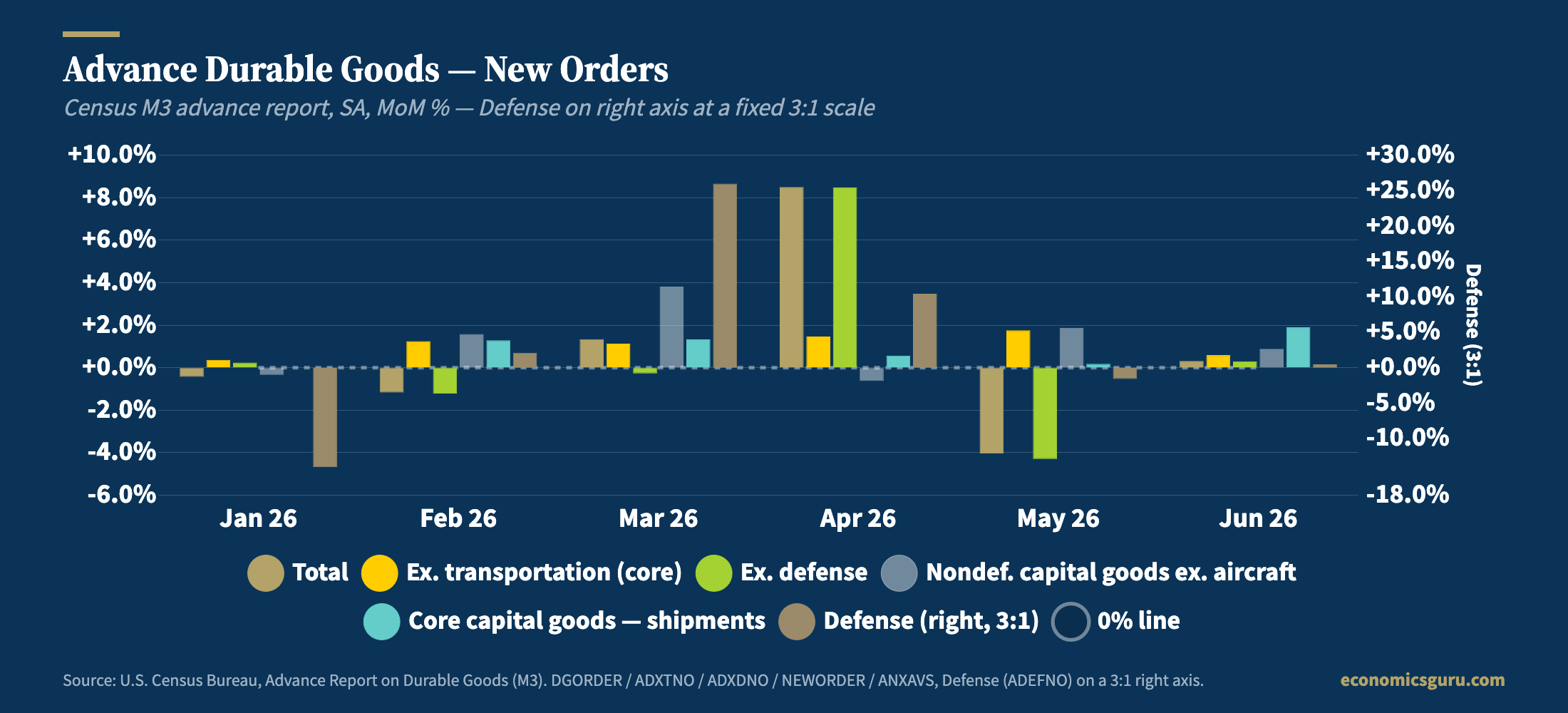
However, as usual, the details are important. Strip out transportation — planes and cars, by far the lumpiest part of American manufacturing, where Boeing sells a hundred jets one month, and none the next — and orders rose 0.6% to $220.9 billion. That is the FIFTEENTH consecutive monthly increase and an all-time high. Core capex did the same thing: up 0.9% to $85.1 billion, also a record, and 12.5% above where it stood a year ago.
Why is this important? Core capex, or nondefense capital goods excluding aircraft, is the closest thing we get to a monthly report on what businesses are actually committing to spend on equipment. Stuff like machines, computers, and other equipment they won’t take delivery of for months. And, it feeds straight into the business investment line of GDP. The last time it grew this fast on an annual basis was late in 2021, and we were measuring against the COVID decline. So, while the headline disappointed, core capex spending bodes well for GDP later in the year.
Remember that these are nominal dollars, and capital equipment prices are up about 3.6% over the past year, so the real number is closer to 8.5%, but that is still plenty strong. It is interesting to note that computers and electronic products led the entire increase, up 3.1% to $31.1 billion, and it has been higher in nine of the last ten months. So what does that mean? It means that a lot of what is clearly a “manufacturing recovery” is actually data-center build-out. But I’ll take it.
Keep reading with a 7-day free trial
Subscribe to Alfie Meek's Weekly Economic Digest and Commentary to keep reading this post and get 7 days of free access to the full post archives.